Beneath the glow of the brightest moon of the year, a nation pauses. Airports are jammed with families carrying gift sets of Spam and expensive oil. Cities quiet down, and the countryside hums with an energy that is both solemn and celebratory.
This is Chuseok (추석), often called ‘Korean Thanksgiving,’ but that title barely scratches the surface. It is a three-day holiday where modern Korea steps into a time machine, traveling back to its agrarian roots to honor the past, feast in the present, and play under the harvest moon. Today, through this piece of writing, let’s visit Chuseok together.
More Than a Meal: The Soul of Chuseok

At its heart, Chuseok is about gratitude and ancestry. It is a harvest festival, a time to give thanks for the year’s bounty. More importantly, it is a sacred obligation to one’s family, both living and departed.
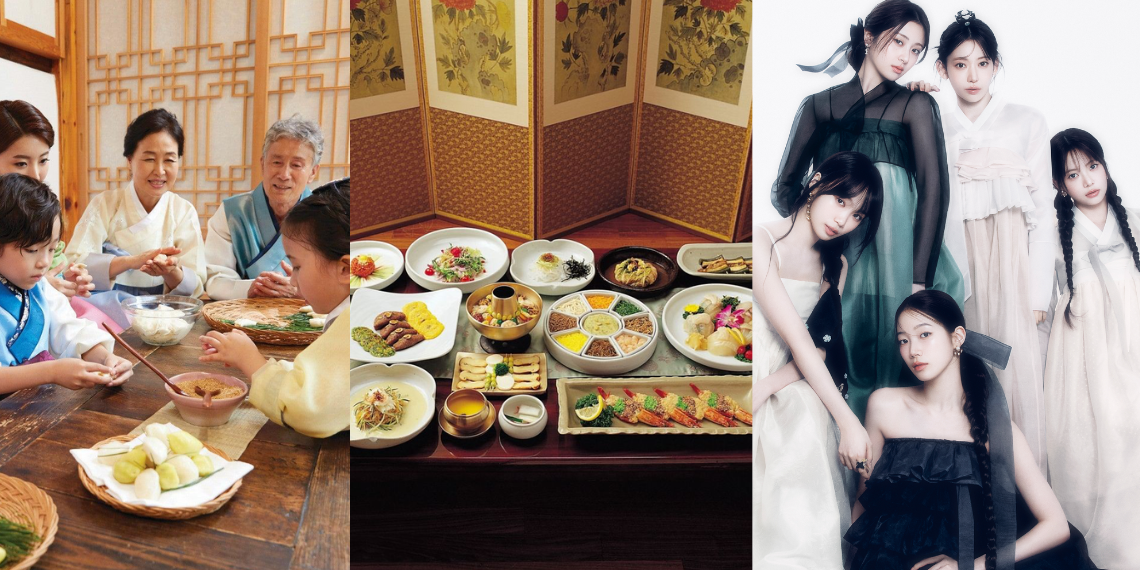
The morning begins with Charye (차례), a solemn ancestral memorial rite. Families gather in their homes, and a table is meticulously set with offerings of various kinds of food: newly harvested rice, fresh fruit, songpyeon (half-moon rice cakes), and grilled meats. It is a silent, respectful thank-you to the generations that came before, an acknowledgment that their work led to this abundance.
Following Charye is Seongmyo (성묘), a visit to the ancestral gravesites. Families clear the summer overgrowth from the burial mounds, tidying the area as a show of respect and remembrance. It is a physical act of honoring one’s lineage, connecting to the land and family history.
The Taste of Chuseok: A Bite of Tradition

Chuseok cannot be separated from its food. This is where the holiday’s essence becomes deliciously tangible.
- Songpyeon (송편): The undisputed star. These petite, half-moon-shaped rice cakes are stuffed with sweet fillings such as sesame seeds, honey, or red bean paste. The magic happens when families gather to make them together, steaming them over a layer of pine needles, which imparts a fragrant, earthy aroma—the literal smell of Chuseok. The crescent-moon shape symbolizes a bright future and hope.
- Jeon (전): An assortment of savory, pan-fried pancakes made with ingredients such as zucchini, fish, or kimchi. Crispy, slightly oily, and utterly irresistible, they are the perfect savory counterpoint to sweet songpyeon.
- Bae (배) and Sanchu (상추): Korean pear and leafy greens. These are used to wrap bites of grilled meat, providing a fresh, crunchy element that cuts through the richness of the feast.
The Playful Moon: Games and Ganggangsullae

Once the rites are complete and the feast is eaten, Chuseok transforms into a celebration. Traditional games breathe life into the holiday.
Villages would hold wrestling competitions (Ssireum, 씨름), in which the strongest men grappled for a prize, such as a bull or a piece of cloth. Women and girls would swing high on giant swings (Geunettwi, 그네뛰기), their colorful hanbok soaring into the sky, symbolizing a wish for a good harvest.
But the most iconic is Ganggangsullae (강강술래), a traditional circle dance performed under the full moon by women. They join hands, sing, and spiral in and out of formations. It is a mesmerizing, beautiful performance that feels both ancient and immediately joyful.
Chuseok in the 21st Century

Today, Chuseok is a mix of old and new traditions. The journey from cities to hometowns, known as the ‘Chuseok Journey,’ is a massive traffic snarl that is both dreaded and accepted. Gift sets of prime beef, fruit, and health supplements are exchanged. For those who cannot travel, or for foreigners curious to experience it, major folk villages like the Korean Folk Village in Yongin hold spectacular reenactments of all the traditions, from the rites to the games.
A Visitor’s Tip

If you’re in Korea during Chuseok, don’t expect the bustling streets of Seoul. Many shops and restaurants close as people return home. Instead, seek out a folk village or public celebration. And if you’re invited into a Korean home, it is the highest honor, one that comes with a gift. Be ready to eat, laugh, and perhaps even learn how to make a perfect songpyeon.
Chuseok is more than a holiday; it’s a national mood. It’s a reminder of where Korea came from—an agrarian society bound by family and season. It’s a living ritual that continues to define the present, a powerful, annual touchstone of identity. It’s a full moon, a perfect songpyeon, and the feeling that, for a few days, time truly stands still.
Happy Chuseok!
Written by – Trisha Deka
Connect with us on Instagram | X | YouTube for more content, interviews, & news.