For decades, one of the first things that confused many foreigners in South Korea wasn’t the language, the food, or even the subway system – it was age. How could a child born in December 2000 be considered two years older than a child born in January 2001, even though they were just a few weeks apart? The answer lay in the Korean age system.
However, on 28 June 2023, South Korea officially said goodbye to this unique way of counting age in legal and administrative settings. Let’s explore what changed, what didn’t, and why it matters for anyone interested in Korean culture.
What was the Korean age system?
Under the traditional Korean Age system, every person was considered one year old at birth. Then, on January 1st of every year, everyone added another year to their age regardless of their actual birthday. That meant a baby born on December 31st would turn 2 years old the very next day. Meanwhile, a child born on January 1 would wait nearly a full year before gaining another year under the same system.
This method of calculation was rooted in long-standing cultural beliefs. In Confucian-influenced East Asian societies, the time a baby spent in the mother’s womb was tradionally counted as the first year of life. The practice of everyone aging together on New Year’s Day also reflected agricultural cycles and a community-oriented mindset. Age was more than just a number—it influenced social hierarchy, determined who used terms such as “oppa” or “unnie,” who poured soju with two hands, and even where people sat at the dinner table.
Why did it confuse everyone?
For international fans of K-dramas, K-pop, or Korean business culture, Korean age was often a puzzle. Imagine watching a variety show where someone who was 24 years old internationally was treated as a senior because their Korean age was 26.
The confusion wasn’t just limited to entertainment or tourism. Even within Korea, the system sometimes created administrative and legal complications. Schools, contracts, and admissions often had to navigate different age standards. At oen point, the government itself used three different age-counting systems: one for social everyday use, another for specific legal matters such as juvenile protection, and a third for most official documents.
What was the June 2023 law change, and what actually happened?
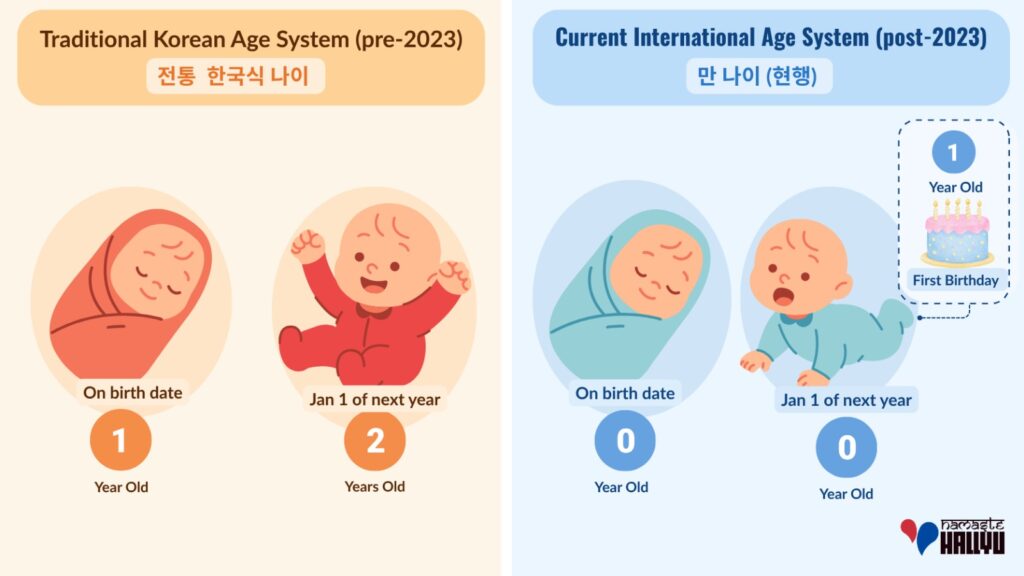
In June 2023, the South Korean National Assembly passed legislation requiring the international age system (만 나이 – Man-nai) to be used for legal and administrative purposes. From that point forward, official documents such as driver’s licenses, passports, and government records would follow the same age calculation system used in most countries around the world.
The government goal was simple and straighforward: reduce confusion, align with international standards, and make life easier for Koreans and foreigners. For the first time, a baby born on December 31st would be considered 0 years old, just as in most other countries.
What did not change?
This is where th story gets more nuanced and where many headlines missed an imprortant detail. The Korean age did not disappear from everyday life.
In social settings, when two Koreans meet for the first time, they still often ask, “How old are you?” expecting an answer using the traditional counting method. The reason lies in language and social structure. This is important because Korean speech levels, particularly the distinction between jondaetmal (honorific form) and banmal (casual form), are closely tied to age and seniority.
While the legal reform standardized age calculations in official settings, centuries-old social customs cannot be changed through legislation alone. The administrative system has been unified, but many cultural practices surrounding age continue to shape everyday interactions.
Why does this matter for international fans?
For people outside Korea, this change is both a relief and a valuable lesson. It’s a relief because you no longer need a mental calculator to understand a Korean celebrity’s birth year. When BTS’s Jungkook says he was born in 1997, his official age is simply 2026 minus 1997, no additional math required.
At the same time, the reform offers an important insight into how societies evolve. Laws can change quickly, but culture often changes more gradually. The 2023 age reform reflects South Korea’s position as a highly globalized nation seeking greater alignment with international standards. Yet the continued influence of traditional age-based customs demonstrates how deeply cultural practices are embedded in everyday life.
The legal unification of age calculation was a significant step forward in reducing confusion. However, social habits and cultural norms evolve over time, and that process is both natural and expected.
Written by: Daxta Pandey
Connect with us on Instagram | X | YouTube for more content, interviews, & news.